Specialized services

Myopia control in children and adults
To assess and monitor myopia progression, we use an optical axial length measurement device (IOL Master). This technology allows us to measure the length of the eye and monitor changes over time. Axial length measurements help us assess myopia progression and follow eye growth after a myopia control method has been introduced. They can also contribute to the assessment of risks associated with certain eye conditions later in life.
Read more
Make an appointment now!
ONE OF OUR OPTOMETRISTS WILL MAKE A GLOBAL ASSESSMENT OF YOUR VISION THROUGH OUR FULL VISUAL EXAMINATION.
Make an appointmentOur clinic has used orthokeratology for myopia control since 2006. Several approaches may be considered depending on the patient's situation. They aim to slow myopia progression and eye elongation.
- Orthokeratology (Ortho-K or night lenses) - appointments with Dr. Patrick Simard
- Custom contact lenses, including multifocal rigid gas-permeable (RGP) lenses, hybrid lenses and customized soft lenses
- Essilor Stellest lenses
- HOYA MiYOSMART lenses
- Essilor Myopilux Plus lenses
- Bifocal lenses adapted to the patient's visual needs
- Atropine
Orthokeratology: night lenses for myopia control
Orthokeratology is also known as Ortho-K. It involves wearing rigid gas-permeable (RGP) contact lenses overnight. These lenses temporarily reshape the cornea. The central cornea becomes flatter and the peripheral cornea becomes steeper. This approach can improve daytime vision and help control myopia.
How does orthokeratology work?
Orthokeratology produces two separate effects:
- Flattening the central cornea can correct up to approximately 4.00 diopters of myopia. This may allow the patient to see clearly during the day without glasses or contact lenses.
- Changes in peripheral corneal curvature can help control myopia. In children, the goal is to slow its progression over time.
These two effects are independent. If myopia is greater than -4.00 diopters, a mild glasses prescription may still be needed. The intended myopia control effect may still be maintained.
How much does orthokeratology cost?
The initial fitting fee is $300. Several follow-up visits are then required. Visits are scheduled after 1 week, 1 month, 3 months and 6 months. Follow-ups then take place every 6 months. The initial fitting fee is non-refundable.
Orthokeratology lenses are available from $700 per pair. They generally last 1 to 2 years, depending on wear. If treatment is discontinued during the first two months, the cost of the lenses may be partially refundable.
What warranties apply to Ortho-K lenses?
- Breakage warranty: 3 months from the date of purchase.
- Fitting warranty: 3 months from the date of purchase. Regular follow-up visits are important during the first few months.
RAMQ reimbursement: the program available to eligible children may provide $300 in reimbursement every two years. Eligibility depends on the program's current requirements.
Learn more about myopia and myopia control:
Custom contact lenses for myopia control
During the eye exam, the optometrist will assess which contact lenses are best suited to the patient. Visual needs and budget will also be considered. Daily or monthly lenses may be recommended depending on the situation.
Essilor Stellest lenses for myopia control
Essilor Stellest lenses correct myopia. They are also designed to help control its progression and eye elongation.
Learn more about Essilor Stellest lenses
HOYA MiYOSMART lenses for myopia control
HOYA MiYOSMART lenses use D.I.M.S. (Defocus Incorporated Multiple Segments) technology. They correct vision while helping to control myopia in children. According to HOYA, the technology also helps reduce eye elongation.
Learn more about HOYA MiYOSMART lenses
Essilor Myopilux Plus lenses
Essilor Myopilux Plus lenses are bifocal spectacle lenses. The upper portion provides distance correction. The lower portion provides near vision correction.
Atropine for myopia control
Atropine may be used at different concentrations. It can be used alone or combined with other myopia control methods. The recommended approach depends on the patient's situation.
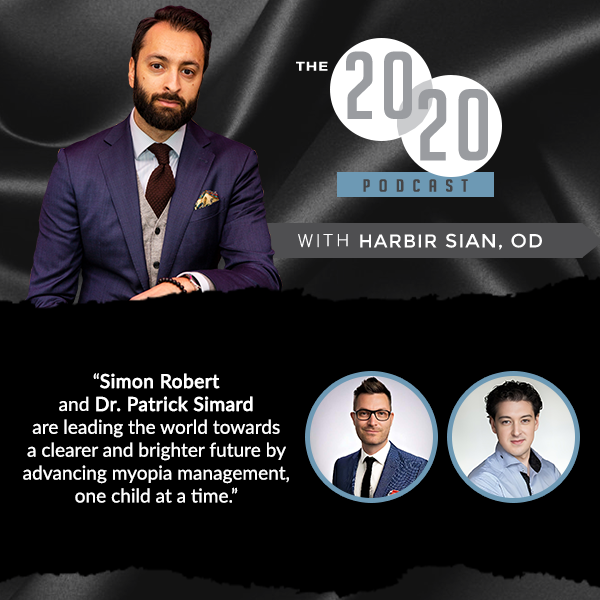
Podcast on myopia control with Dr. Patrick Simard and Simon Robert